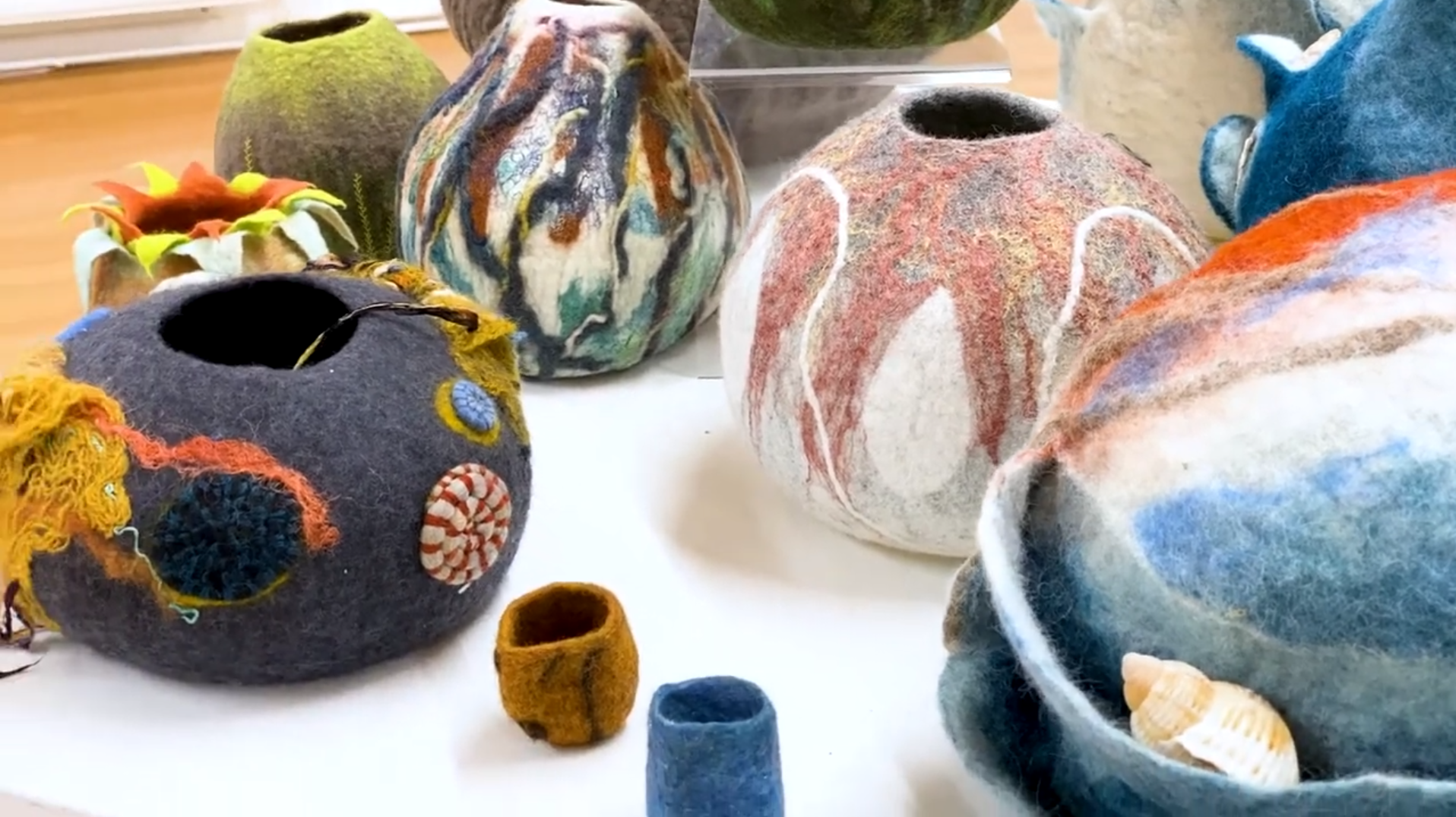
After colour has been explored, shapes noticed, lines followed, and textures felt, something begins to shift.
Ideas stop hovering.
They start to take up space.
This is where Form enters the process.
Form is the moment when a piece becomes physical… when it has weight, volume, and presence. It can be held, turned, viewed from different angles. It exists in the world rather than just in the imagination.
For many artists, Form is both exciting and unsettling. It asks the work to commit.
Form Is Not About Finish
It’s easy to mistake form for completion ~ to assume that once something has a clear form, it must be finished or resolved. But form doesn’t mean polish.
Form is simply structure.
It’s how a piece holds itself.
How it stands, curves, collapses, or contains space.
How it behaves when it’s no longer flat.
In textile and fibre work especially, form often emerges gradually. It’s shaped through handling, adjustment, living with the work for a while. It changes as the material responds.
Form doesn’t demand certainty.
It invites relationship.
Letting the Work Take Up Space
One of the quiet shifts we see in DesignPlus is the relief that comes when work finds form.
👉 Join the waiting list to get the link to our next DesignPlus Discovery call
Once a piece becomes dimensional, decisions feel less abstract. Artists can respond to what’s actually there rather than what they imagine should be there.
You can turn the work.
Notice how light falls across it.
Feel where it holds tension or ease.
Form grounds the creative process. It brings ideas out of the head and into the hands.
Form Grows from What Came Before
Form doesn’t appear in isolation.
It grows out of:
colour choices already made
shapes that have been explored
lines that guide movement
textures that give depth and resistance
When these elements have been given attention earlier in the process, form feels less intimidating. It becomes a natural next step rather than a leap.
In this way, form isn’t something you force.
It’s something you arrive at.
Living with Form
One of the most valuable practices around form is simply living with the work.
Allowing a piece to exist in its current state.
Resisting the urge to immediately fix or resolve.
Letting the form settle before asking what comes next.
Often, clarity arrives not through action but through time.
Form benefits from patience.
Form and Confidence
For many artists, form brings a new kind of confidence.
Not the confidence of knowing everything in advance - but the confidence of recognising that the work is real. That it has substance. That it can be responded to and refined.
Form allows artists to trust that what they’re making is something, even if it’s still evolving.
That trust matters.
Learning Form Together
Working with form inside a group can be especially powerful.
Seeing how others approach dimensional work ~ how they problem-solve, pause, adapt ~ helps normalise uncertainty. Conversations around form often sound like:
“I wasn’t sure if this would hold.”
“I didn’t know where it was going until it stood up.”
“It changed once I could see it from the side.”
These shared reflections reduce pressure and increase confidence.
Form becomes something to explore, not a test to pass.
Letting the Work Stand
As the final design principle in this series, Form invites us to pause.
To notice what has already been built.
To let the work stand as it is … imperfect, evolving, present.
If you’re working with form right now, try asking:
What does this need in order to hold itself?
Sometimes, that’s less intervention than you think.
Form doesn’t ask you to finish.
It asks you to let the work exist.
And that, in itself, is a meaningful step.
👉 Join the waiting list for our next DesignPlus Discovery Call to explore the design principles in a small, supportive creative community… and Find Your Birds!